
Omron E3JK-TR11 2M Through-beam Photoelectric Sensor
The E3JK-TR11 2M is a through-beam photoelectric sensor designed for reliable long-range object detection in industrial automation systems. Using a separate emitter and receiver setup, this sensor ensures stable detection even in challenging environments where accuracy is critical. It operates on a wide AC/DC power supply and features a relay output for flexible integration with control circuits. The pre-wired 2 meter cable simplifies installation, while selectable operation modes enable adaptability across different sensing conditions. Manufactured by Omron, the E3JK-TR11 is part of the Omron Photo Sensors range known for consistent performance and industrial durability.
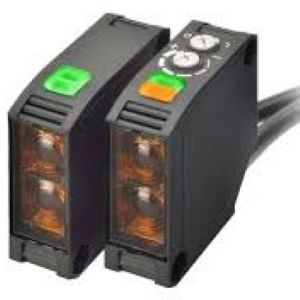
| Brand | Omron |
| Product | Photoelectric Sensor |
| Model Number | E3JK-TR11 2M |
Omron E3JK-TR11 2M Through-beam Photoelectric Sensor – Technical Overview
| Specification | Value |
|---|---|
| Sensing Method | Through-beam |
| Emitter | E3JK-TR11-L 2M |
| Receiver | E3JK-TR11-D 2M |
| Sensing Distance | 40 m |
| Output | Relay |
| Connection Method | Pre-wired Cable, 2 m Length |
| Operation Mode | Light-ON / Dark-ON selectable |
| Light Source | Red LED |
| Response Time | 20 ms max. |
| Power Supply | 24–240 VDC / 24–240 VAC, 50/60 Hz |
| Degree of Protection | IP64 |
| Material | ABS |
The Omron E3JK-TR11 2M is a dependable through-beam sensing solution built for applications where uninterrupted object detection is required over extended distances. By separating the transmitter and receiver, the sensor minimizes detection errors and provides consistent switching performance, making it suitable for precision-based automation tasks.
This sensor is widely used in industrial setups such as conveyor systems, packaging lines, and material handling equipment where continuous monitoring of moving objects is essential. Its design allows stable operation even in environments with dust, vibration, or varying light conditions, ensuring reliable signal output in real-time processes.
Engineered for durability, the Omron E3JK-TR11 2M supports long-term operation with strong electrical insulation, efficient power usage, and robust construction. Its industrial-grade housing and stable sensing capability make it a preferred choice for automation systems that demand accuracy, repeatability, and minimal maintenance over extended usage cycles.