
Omron WLD3 Top Ball Plunger Limit Switch
The Omron WLD3 is a top ball plunger limit switch designed for precise linear position detection in industrial automation applications. This model uses a plunger actuator with a hardened ball tip, enabling smooth vertical actuation and reduced wear when interfacing with cams or sliding machine components. Built as a standard load, built-in switch, it supports stable and repeatable switching for control circuits in automation panels. The rugged metal housing and sealed construction allow reliable operation in demanding environments. Manufactured by Omron, the WLD3 belongs to the Omron Limit Switch, known for long mechanical life and dependable limit detection.
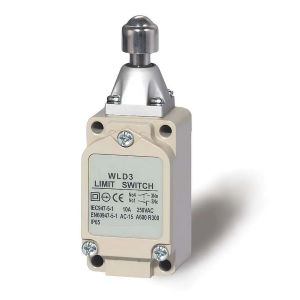
| Brand | Omron |
| Product | Limit Switch |
| Model Number | WLD3 |
Omron WLD3 Top Ball Plunger Limit Switch – Technical Overview
| Specification | Value |
|---|---|
| Actuator | Top Ball Plunger |
| Contact Form | DPDT |
| Contact Configuration | Two-Circuit |
| Rated Switching Capacity | 10 A at 500 VAC |
| Current Rating | 100 mA |
| Voltage Rating | 125 VAC / 30 VDC |
| Mechanical Life | 500,000 operations |
| Electrical Life | 10,000,000 operations |
| Electrical Application | General control circuits |
| Degree of protection | IP67 |
The Omron WLD3 is widely recognized as an Omron plunger-type limit switch developed for consistent and accurate mechanical sensing in industrial automation systems. Its top ball plunger actuator ensures smooth engagement with moving parts, providing reliable switching even under repetitive motion conditions.
In industrial applications, the Omron WLD3 is commonly used in machine tools, presses, conveyors, and automated assembly equipment where vertical stroke or end-position detection is required. The compact plunger design allows installation in confined spaces while maintaining precise actuation points.
Designed for long-term industrial use, the switch features a robust enclosure, stable internal contacts, and environmental protection suitable for continuous operation. These characteristics make the Omron WLD3 a dependable choice for limit detection in demanding production environments.